Info

You are currently browsing the Well Red weblog archives for November, 2011.

November 2011
M T W T F S S
« Oct   Dec »
 123456
78910111213
14151617181920
21222324252627
282930  

Archive for November 2011

Sabam vs Scarlet, the People vs. Copyright

The European Court rules to balance the rights of copyright holders against citizenship rights. Finally some sense from the courts. The SABAM vs Scarlet case from Belgium has finally reached the end of the road. The European Court of Justice has ruled that EU Law prohibits national courts from forcing Internet Service Providers (ISPs) to filter and block all users, including alleged and proven copyright infringers.

The ruling balanced the rights of all Europe’s citizens, the rights of the ISPs and the rights of copyright holders and decided that

  • the right to freedom of speech and expression
  • the right to conduct a business
  • and the right to privacy

are all of significance and are not outweighed by copyright holder rights to tax the use of their content. Basically copyright holders are going to have find the criminals, not pursue the innocent.

The organisation European Digital Rights, in an article Scarlet/Sabam Ruling a vital victory for Internet freedoms argue that the ruling prohibits a national court, including the Supreme Court of the United Kingdom, the organisation once known as the House of Lords Judicial Committee, from instructing an ISP to install and run a monitoring and blocking system in the interests of copyright holders. In fact Sabam, the Belgian version of the Performing Right Society, asked,

whether a national court may order ISPs to install a filtering and blocking system for all its customers for an unlimited period, in abstracto and as preventive measure under EU law and if this was in line with the Charter of Fundamental Rights. The Court of Justice of the European Union answered that such a measure is contrary to European legislation and that it violates fundamental rights in particular the right to privacy, freedom of communication and freedom of information. It also breaches ISPs’ right to conduct business.

Phil Muncaster at v3.co,uk in an article European court rules that ISPs can’t be forced to block pirated content reports on the ruling and quotes the judgement as saying,

“EU law precludes the imposition of an injunction by a national court which requires an internet service provider to install a filtering system with a view to preventing the illegal downloading of files,”

The BBC report the ruling here….EDRI again, argue that

The measure requested by SABAM is only incompatible with EU law because it does not meet the legality test set out to enable restriction to fundamental rights, i.e. the criteria of proportionality, necessity and effectiveness.

Furthermore, law should be sufficiently clear, accessible and foreseeable, and it (sic) that particular case it was not.

It would seem that SABAM’s requests under the injunctions in the Belgian courts were exceptionally broad, but one conclusion we can draw is that SOPA-like laws cannot be passed by the national legislatures of EU member states, so what impact will this have in the UK. Surely this must change the context in which the appeal by BT and Talk Talk of the judgement in the DE Act judicial review occurs.

BT and Talk Talk ’s lawyers argued in court earlier this year that the UK’s Digital Economy Act contravened several tenants of EU Law. Basically Justice Parker disagreed striking down the arguments that the Law had to be consulted with Commission, that it was in breach of ISP’s common carrier and single market obligations, that it was an overly onerous obligation placed by the state on a telco business. He also ruled that the law did not breach the ISP’s customers’ fundamental rights to privacy.
The Judical Review judgement can be read here…. My long review is published on this blog here. The judge defines certain discretion to the legislature; it would seem to me that the ECJ have narrowed this level of discretion.

Mr Justice Parker ruled that the “Initial Obligations Code” of the DE Act had not been published and therefore there was no need to consult the EU Commission, and nor could he review it. But one has to wonder if after this ruling whether the proposed “Technical Measures” to be applied to alleged copyright infringers under the DE Act will be deemed illegal on the grounds that they are disproportionate (and lets face it ineffective). AtThe UK court stated that proportionality was a matter forParliament, the ECJ my have stated that ts a matter for the courts. At least this ruling must ensure that the courts review and take seriously BT’s duty of privacy to its customer. BT and Talk/Talk plan to return to court to appeal the Regina vs Secretary of State judicial review. Let’s hope the robust ruling of the ECJ will make the Judge’s job easier.

The other major case in the UK is even more interesting. This is the newzbin2 case. If filtering and blocking is disproportionate, even if newzbin2 remains deemed to be a criminal site, surely the copyright holders will now have to pay for the site blocking. Also all BT’s caveats to the injunction which the judge dismissed must now be reviewed. The fact that

  • the injunction is unlimited in duration (disproportionate, and a factor in the ECJ’s ruling)
  • BT can’t moderate their compliance for emergency operational reasons without permission from the court, from the plaintiffs (disproportionate, restraint of trade, breach of consumer rights)
  • BT must pay for the enforcement (restraint of trade)
  • BT must apply the filtering to all their customers (many businesses and government customers don’t want/permit “Cleanfeed” filtering on their lines) (breach of freedom of information, restraint of trade), this might be a killer
  • BT have no right to claim consequential liability for false accusation (disproportionate)

It might not be a new dawn, but after the appalling run of legal precedents in the UK, Europe and the USA, this at least is a restatement that copyright trolling is not a human right because it’s not. The Copyright law is a political agreement and settlement between creators and the polity. They have no right to the last word.


See also http://www.rawstory.com/rs/2011/11/24/eu-court-rules-against-web-filters-to-block-file-sharing/http://europa.eu/rapid/pressReleasesAction.do?reference=SPEECH/11/777&format=HTML&aged=0&language=EN&guiLanguage=en

What am I saying

Sometime, you just have to use a Wordle, here’s mine of this blog, as at today.
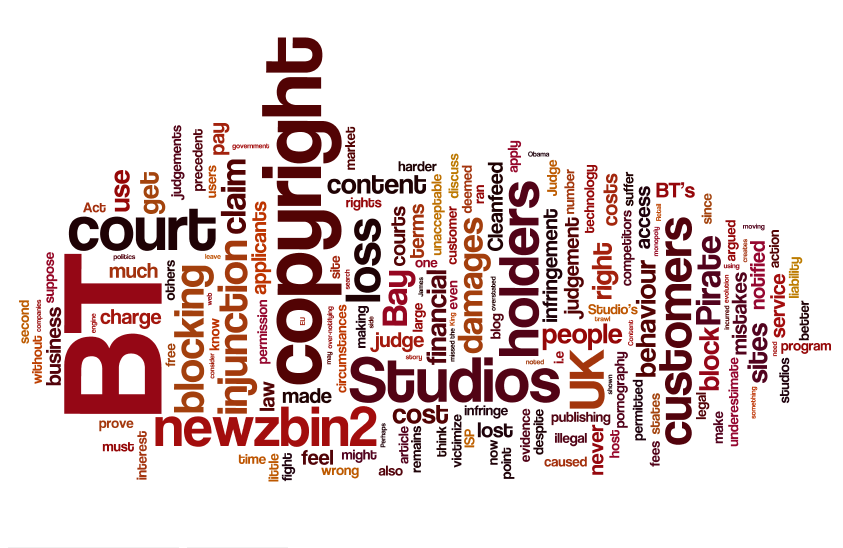

Wordle: blog.davelevy.info
 
You can click through to the wordle page.

And for our next trick, we’ll make the Pirate Bay disappear

The Guardian ran a story yesterday which states that a coalition of music publishing corporations have threatened BT with court action to get them to “block” the Pirate Bay since they feel they have a legal precedent in the newzbin2 judgements.

The Pirate Bay, Logo

They’re wrong!

A key part of the judgement is that newzbin2 charge fees under terms for the right to use their NZB program, which permits the assembly of usenet posts into usable content. This is deemed by the court to be an inducement to infringe copyright, despite the fact that newzbin2 do not know if their program is used to assemble copyrighted material without permission and host no content themselves.  I discuss this in passing in my blog article, “Censoring the Internet”, published earlier this year.

The Pirate Bay is a linking site. It doesn’t charge, it has no commercial relationship with its users i.e. those individuals who may infringe copyright.

Under UK & EU law, link sites are legal.

In order to get an injunction, the copyright holders, and their agents will need to prove that the Pirate Bay induces copyright infringement by actions other than publishing the links, and that they i.e. the copyright holders suffer financial loss. In the newzbin2 case, newzbin2’s fees are a demonstrable loss to the copyright holders. Pirate Bay don’t charge pirates, they are a search engine, they host no content and can claim a common carrier defence.

The newzbin2 judgements are not a precedent for the Pirate Bay.

James Firth, on his digital rights blog, also comments on this insidious action and has previously argued that UK civil courts do not have easy access to public interest arguments and there is little doubt that this is needed here.

In my article More on the Newzbin2 affair, I begin to explore the equity in allowing Industrial Content to victimize BT and its customers. At the moment the financial cost is quite low, but free speech is about access to ideas as well as the right to promulgate them. As a BT customer I and millions of others are now disadvantaged because a court has permitted copyright holders to discriminate against us. (It’s only BT customers who can’t access newzbin2.)

In the second judgement, the court stated that there was no evidence that copyright holders would notify BT of sites that were not the subject of the injunction. I argued that the behaviour of the bulk of corporate copyright holders has never been to underestimate web publishers and users complicity in infringement, and never to underestimate their financial loss, despite never having proved it, at least not in UK courts.  This letter to BT is yet more proof that except under financial penalty or some other court supervision, they will and always have overstated their rights.

Basically they assume that the only alternative to piracy is payment of monopoly prices, and that’s not true, and they’ve made up the figures as to how much they lose. If a pirate would not buy the content, then the copyright holders have not lost out financially and UK law requires them to prove loss.

This is bullying. As a BT customer I’d prefer to fight them. So if you get to read this, Ian Livingston, you know what I think!

As a postscript, it says something that a group of people can make one feel sorry for or even supportive of BT.

More on the Newzbin2 affair

Last week, BT and the Movie Studios returned to court to discuss the terms of the newzbin2 injunction. The judgement is a pretty much a  victory for the Studios. BT must use Cleanfeed to block notified sites, they must use it to block all addresses notified by the applicants, the proposal that only sites that ‘predominantly’ induce copyright infringement should be blocked was rejected, they can’t turn the blocking off for operational reasons without the permission of the applicants, they can’t terminate the injunction in circumstances where the applicants don’t injunct BT’s competitors in a reasonable time frame, BT have to pay for the enforcement, BT have no right to claim damages against the studios for consequential liability,  BT have to pay the studio’s court costs to the point of the initial newzbin2 injunction, costs incurred after the injunction are born be each side.

It should be noted that all the Studio’s are US based companies.

The blocking technology, Cleanfeed, was built and designed to block unacceptable pornography. This court backed pursuit by the studios will lead to technical evolution that will make restricting unacceptable pornography harder. More people will adopt VPN technology. Pornographers will be harder to fight.

Probably dedicated downloaders will leave BT while it remains the only injuncted UK ISP. The costs are not large, and certainly not large in terms of the number of BT Retail customers.  I am unclear if BT Global Services have to apply Cleanfeed to the majority of their business customers who don’t currently subscribe to this service, and what this might cost.

It’s the point about equitable treatment that I feel is unfair to BT, and creates a market distortion. The judge has permitted the Studios to victimize the largest UK ISP and as such means that it is now in an uncompetitive position to trade. It’s not just that deemed illegal activity is unavailable at BT while remaing so at its competitors; BT’s customers have to pay the additional cost of enforcing the injunction.

In the discussion about whether BT could claim damages against the Studios for loss of business, the judge drew the conclusion that the only damages BT would suffer would be claims from customers about loss of service, which since the judge deems the service lost to be an illegal one, he’s not too fussed. The second cause of loss might be liability caused by wrongful blocking due to mistakes made by the Studios.  He states that he considers the risk of the Studios over-notifying candidates for blocking to by negligible or minor. (Actually, the judgement states there is no evidence that this would occur). I’d suggest that the behaviour of the customers of some law firms in the USA and Europe, such as ACS Law shows that some copyright holders have little interest in the accuracy of their data when asking for remedy, shown by the number of people caught in their trawl who plausibly claim complete innocence. Bad behaviour is pervasive enough for the term Copyright Troll to have come into existence,  The Judge says that he accepts mistakes can be made, if so why doesn’t he support BT’s right to claim damages in circumstances that a notified candidate for blocking is wrong. While making mistakes remains cost free, they are more likely to happen, even more so in a profit making organisation.

Also in looking at counter damages, the Judge missed the lost business caused by people that don’t want to subsidise the Studios profits moving to non-injuncted providers. He also maintains that the decision to apply for injunctions against other ISPs is that for the Studios.  If BT consider that the Studios are using the courts in an anti-competitive manner, they’ll have to return to court, presumably on the basis of changes in market and/or the Studio’s behaviour after the site blocking is implemented.

Three Wise Men, caption competition

The London Evening Standard ran this picture, with some rubbish about how Cameron brought his intellectual friend along to get Obama to lean on Merkel and Sarkozy to rescue the Euro (and lets face it, the Pound). Perhaps you can do better…
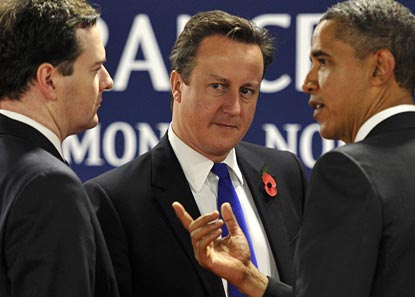
Obama, Cameron and Osboure, 3 Wise Men

Please comment…

Royal Equality and Digital Freedom

So the #CONDEM government plans to introduce a “Royal Equality Act” before the next General Election. What do you suppose that’ll do then. Make the Royals equal to the rest of us? Levy taxes on their private income, Remove the Prince of Wales veto on UK politics? Nah! It’s about who succeeds King William!

I suppose that @Nick_Clegg will have to let the Tories bang on about this and agree to the use of parliamentary time, but I remember his promise to Repeal the Digital Economy Act, so in my mind and that of many others, I can think of much better things our politicians should be doing. The “Great Freedom Bill”, this ain’t.

|